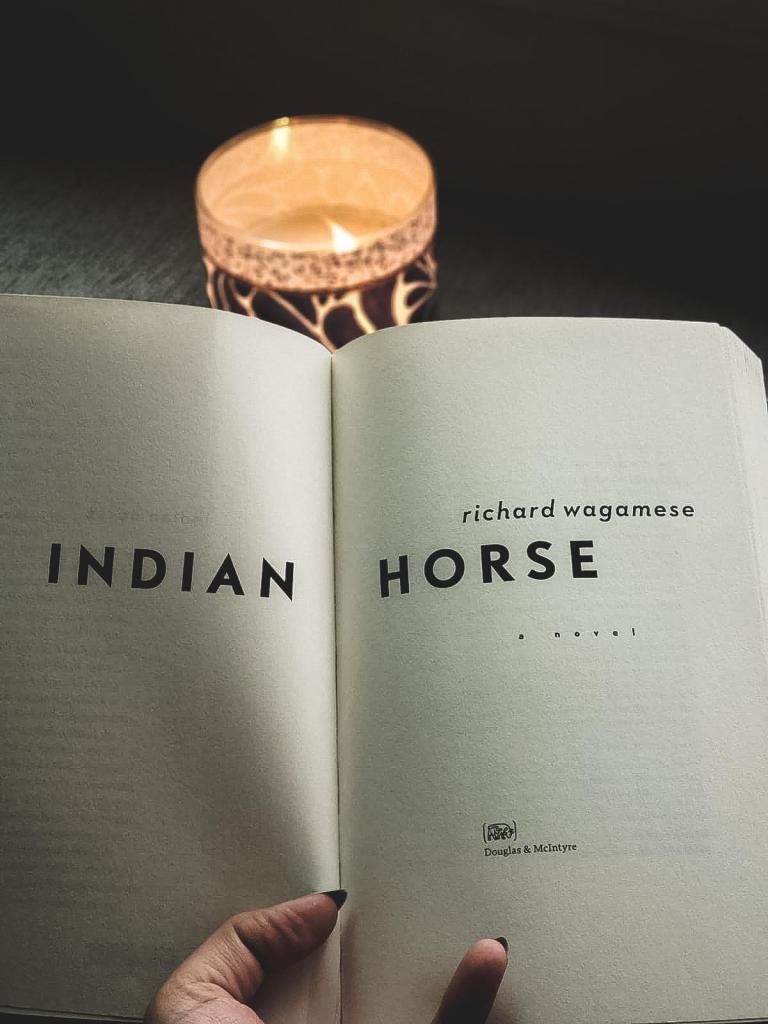
Richard Wagamese presents Indian Horse through the first person perspective of Saul Indian Horse, an ex-hockey star, who takes readers through the traumatic life he has endured and survived. This book is set in yet another very dark moment in Canadian history; the residential school era. A victim of the Canadian residential school system, Saul’s story is filled with pain, sorrow, and at times mild hope. After being forcefully taken from his family, Saul is thrown into a residential school where he is forced to forget his Ojibway language and culture; forced to forget his identity.
Saul finds solace in his new found love – ice hockey. Everyone who watches him play can tell that this boy is gifted. Having being blessed with a strong innate ability to excel at ice hockey, Saul gains confidence, new relationships, and a sort of freedom, however, he cannot get away from the atrocities that transpired in the residential school. Not only is Saul haunted by the memories of residential school, Saul faces racism and mistreatment at the hands of various people throughout his life. Despite ice hockey providing a type of escape for him, Saul continues to spiral and crush under the weight of the trauma.
Although it is fiction, this short, yet clear read, does a spectacular job of telling a story that is basically true for a lot of victims of the residential schools. Not only were the children who were in residential schools victims, their families and communities were also victims, forever battling to recover from the trauma. Richard Wagamese did an amazing job in my opinion with this novel. Indian Horse is definitely one of one of the top books that I recommend everyone to read, and I personally think it should be recommended to read in the school systems. Despite the growing attention on what residential schools were really like and the injustices that occurred, many people, even Canadians, do not know much about what took place.
Residential schools were put into place to assimilate Indigenous people into Euro-Canadian culture. The government teamed up with Christian missionaries in hopes to convert the students, a tactic to isolate them further from their cultures. Essentially the goal of the government was to “kill the Indian in the child” and in order to do so, Indigenous families were torn apart when the RCMP and other government agents forcefully removed Indigenous children to put them into the residential schools. In these so called “schools,” Indigenous children were isolated from not only their families, but also their cultures, languages, and traditions. They were forbidden to do anything that would acknowledge their heritage and where they came from. Severe punishments would be assigned to the children if any of the rules were broke. As a result, sexual, physical, psychological, and emotional abuse were all commonly committed by those who were the authorities in residential schools, exploiting and torturing the vulnerable children.
Imagine being practically kidnapped from your home, away from your family and community. Next you’re given a new name and this is just the beginning of your identity being stripped away. Now you’re put into a place where you don’t know the language or culture but you get punished for speaking the only language you know. You have limited, if any, contact with your family. Sexual and physical abuse is so common that it just becomes another daily occurrence and you don’t know what it is like to have a nurturing environment let alone family. Living conditions so poor and unsanitary with overcrowding leading to high death tolls due to lack of food, clean water and the spreading of diseases. Richard Wagamese brings all these issues forward in Indian Horse depicting the life long affects of these atrocities.
I remember growing up in a small town in British Columbia being close friends with a lot of Indigenous people and yet I was oblivious to their history. In fact, I actually remember when in 2008 there were talks about the government delivering an apology to the residential school survivors. One of my close friends was Indigenous and she was speaking to another friend who was Indigenous about the said apology and mentioned how both her parents were in residential schools. I didn’t understand at the time, we weren’t taught about residential schools during my time in elementary or high school, I’m only 25 years old so that’s got to be saying something about how our system just brushed residential schools to the side as if no big deal. However now I realize that her parents were victims of residential schools, and honestly, that isn’t a long time ago, the last residential school closed in 1996!
Filmaker Stephen Campanelli directed the movie adaptation of Indian Horse and actually showed Hollywood star Clint Eastwood. Eastwood was shocked. He asked Campanelli if it was true about the residential school and when Campanelli said yes, Eastwood asked why no one knew about it and signed on as an executive producer in order to help promote the film because he knew everyone needed to see it.
Till this day, the impacts of the residential school system is felt throughout communities. If you have never heard of residential schools or are interested in learning more about this is a great novel to start off with or watch the movie adaptation. Indian Horse was also Highly recommend this novel for anyone in high school and older!
 Nish Jots Her Thoughts
Thank you for recommending this book! Literally made me get inside the mind of the main character. Definitely an amazing book for highschool students in Canada!
LikeLike